| How to prepare your specimen for taxidermy |
| How should I prepare a deer (or other large animal) for a shoulder mount? |
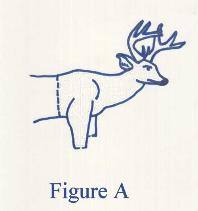
Figure A - First, make a cut 4-
5� behind the front legs,
around the entire body area. If
you are planning on having a â
€œpedestal mountâ€� done,
cut even further back, as these
mounts require more hide.
5� behind the front legs,
around the entire body area. If
you are planning on having a â
€œpedestal mountâ€� done,
cut even further back, as these
mounts require more hide.
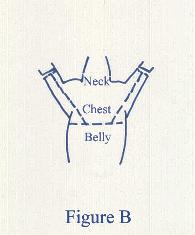
Figure B - Cut up the center of each
leg to the knee joint. Do not cut into
the chest area – this is the brisket
of the deer, and it will show in your
mount! I get in many capes that have
been cut straight up the center of the
brisket, and I have to charge extra for
the time it takes to sew this back
together.
leg to the knee joint. Do not cut into
the chest area – this is the brisket
of the deer, and it will show in your
mount! I get in many capes that have
been cut straight up the center of the
brisket, and I have to charge extra for
the time it takes to sew this back
together.
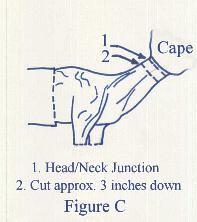
Figure C – Pull the hide down
the neck until you get about 3â
€� from the base of the skull. Cut
through the meat of the neck to
release the cape from the body.
the neck until you get about 3â
€� from the base of the skull. Cut
through the meat of the neck to
release the cape from the body.
| Q- How should I prepare a small mammal for a lifesize mount? |
A- Please freeze your animal whole (do NOT skin or gut first). Skinning a
lifesize mammal for taxidermy purposes is tricky, and if not done by a reliable
taxidermist, could potentially render the hide unusable. Just place the animal
into a plastic bag and freeze until you can get it to the taxidermist.
lifesize mammal for taxidermy purposes is tricky, and if not done by a reliable
taxidermist, could potentially render the hide unusable. Just place the animal
into a plastic bag and freeze until you can get it to the taxidermist.
| Q- I'm not local but I'd like Amy's Animal Art to mount my specimen. What is involved in shipping the specimen to you? |
It’s actually not that difficult! I do lots of mounts every year for people
that have shipped them to me -from as far as Hawaii! Please see the above
instructions for how to prepare your specimen. The specimen needs to be
fully frozen first, and wrapped in a plastic bag.
Place the specimen into a box, and surround it with an insulating material.
Two very good insulators are crumpled newspaper, and strips of house
insulation. Pack the insulation material tight around the specimen. Icepacks
can be added as well, and are especially useful around the head of the
specimen (which tends to thaw first).
A specimen packed in this way will usually stay frozen during its trip. Many
people ask about using dry ice. While it works extremely well, it is a
hazardous material and shipping companies will charge a fee to ship it. In
most cases, dry ice just simply isn’t necessary.
As a general rule, overnight shipping is a must. If the weather is cold, 2nd
day shipping will work as well. It is up to you what shipping service you
choose, but anything over two days (especially during the summer months)
is really putting your specimen at risk – they do not take long to start
thawing out! Overnight FedEx or UPS is recommended. I do not recommend
USPS Express Mail – they are not nearly as reliable.
And that’s all there is to shipping a specimen to Amy’s Animal Art!
Just let me know that you have sent it, so I will be around to receive it ..
Especially if the package will need a signature confirmation.
that have shipped them to me -from as far as Hawaii! Please see the above
instructions for how to prepare your specimen. The specimen needs to be
fully frozen first, and wrapped in a plastic bag.
Place the specimen into a box, and surround it with an insulating material.
Two very good insulators are crumpled newspaper, and strips of house
insulation. Pack the insulation material tight around the specimen. Icepacks
can be added as well, and are especially useful around the head of the
specimen (which tends to thaw first).
A specimen packed in this way will usually stay frozen during its trip. Many
people ask about using dry ice. While it works extremely well, it is a
hazardous material and shipping companies will charge a fee to ship it. In
most cases, dry ice just simply isn’t necessary.
As a general rule, overnight shipping is a must. If the weather is cold, 2nd
day shipping will work as well. It is up to you what shipping service you
choose, but anything over two days (especially during the summer months)
is really putting your specimen at risk – they do not take long to start
thawing out! Overnight FedEx or UPS is recommended. I do not recommend
USPS Express Mail – they are not nearly as reliable.
And that’s all there is to shipping a specimen to Amy’s Animal Art!
Just let me know that you have sent it, so I will be around to receive it ..
Especially if the package will need a signature confirmation.
| Q- Will it cost a lot to have my mount shipped back to me? |
On small mounts, shipping is fairly reasonable. I ship mounts using DHL or
UPS. Depending on where you live, and how large your mount is, return
shipping generally ranges in these categories:
Squirrel or smaller: $20-25
Bobcat, Fox, and similar sized animals: $30-50
Coyote sized: $50-75
Deer/medium game heads: $100-150
An exact quote will be made once the animal is mounted and boxed up.
Most small animals will ship in a well-padded cardboard box, to keep
shipping rates down. Deer heads and similar game heads may need a
wooden crate built for safe shipping. In these cases, a crating fee will be
charged to cover the wood and labor for the crate.
UPS. Depending on where you live, and how large your mount is, return
shipping generally ranges in these categories:
Squirrel or smaller: $20-25
Bobcat, Fox, and similar sized animals: $30-50
Coyote sized: $50-75
Deer/medium game heads: $100-150
An exact quote will be made once the animal is mounted and boxed up.
Most small animals will ship in a well-padded cardboard box, to keep
shipping rates down. Deer heads and similar game heads may need a
wooden crate built for safe shipping. In these cases, a crating fee will be
charged to cover the wood and labor for the crate.